
History

Photo credit: Richmond Times Dispatch

ABOUT > History

A History of Environmental Impact

1977
The Virginia Environmental Endowment (VEE), a private, independent grant-making foundation, came about in a unique way: by court order. In February 1977, the United States District Court for the Eastern District of Virginia fined Allied Chemical Corporation $13.2 million for polluting the James River with the highly toxic insecticide Kepone. With the approval of Judge Robert R. Merhige Jr., a portion of this fine − $8 million − was paid by Allied to fund the creation of the Virginia Environmental Endowment for the purpose of improving the quality of Virginia’s environment.

Judge Robert R. Merhige Jr.

1981-1991
Between 1981 and 1991 VEE received another $1.4 million in court settlements paid by the FMC Corporation, Bethlehem Steel Corporation, Wheeling-Pittsburgh Steel Corporation, IR International, Inc., and Hauni Richmond, Inc. The FMC funds expanded the Endowment’s work in Virginia and beyond into the Kanawha River and Ohio River Valleys. After awarding significantly more funds than the $1 million award received from the original FMC settlement, VEE phased out the K&O Program in 2019 after making over 120 grants totaling nearly $3.5 Million.
2013
On May 31, 2013 VEE’s first Executive Director, Gerald “Jerry” McCarthy, retired after 36 years of exceptional service. The Board of Directors named Joseph H. Maroon to succeed Jerry as Executive Director. Joe has over 40 years of environmental leadership experience. He is a former Agency Director of the Virginia Department of Conservation and Recreation, Executive Director of the Virginia Office of the Chesapeake Bay Foundation, and Principal/Owner of Maroon Consulting. He has also been an adjunct faculty member at the University of Virginia, Virginia Tech, and VCU teaching environmental policy to graduate students.
2017

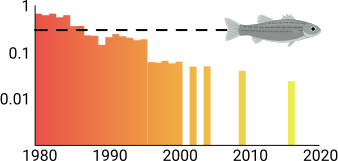
For its 40th anniversary in 2017, VEE commissioned the Virginia Institute of Marine Science to conduct a review of the status of Kepone in the James River. The VIMS analysis showed that approximately 65% of the fish analyzed still have reportable concentrations of Kepone more than 40 years after the event was first discovered, which indicates the persistence of the chemical and how difficult it is to rid a system of a persistent toxic chemical. The good news is that overall, the Kepone in fish tissues is continuing to decline exponentially since 1980.

VEE also asked Christopher Newport University to conduct a poll of Virginians perspectives on the environment. Among its findings was that Virginia voters had become increasingly optimistic about the quality of the Commonwealth’s natural environment, giving it an improved grade from “C” to “B”. Both reports are available on the 40th Anniversary Page.

VEE was also among the organizations to receive funds under a mitigation agreement negotiated by the Commonwealth of Virginia governing the construction of an electric utility line across the James River near historic Jamestown. VEE created the James River Water Quality Improvement Program.

Kepone still persists in the system, but levels in striped bass are decreasing exponentially.
2018

VEE received an additional $3 million from another mitigation agreement which enabled it to launch the Community Conservation Program. This program targets conservation initiatives located within the counties of Craig, Franklin, Giles, Montgomery, Pittsylvania and Roanoke, and the cities of Salem and Roanoke. VEE has used this program to deepen its commitment to community engagement, locally driven conservation, filling gaps in conservation, addressing environmental needs in underserved communities, and supporting organizational capacity, while continuing its long-standing support for policy advocacy and environmental education.

2027

VEE celebrates its 50th anniversary in 2027. The Endowment has worked collaboratively for five decades as a leader and convener, improving environmental quality, advancing environmental literacy, and partnering to establish land trusts, conservation networks, and a statewide mediation center. We look forward to the next 50 years of investing in collaboration and long-term solutions to protect Virginia’s natural resources and environment.